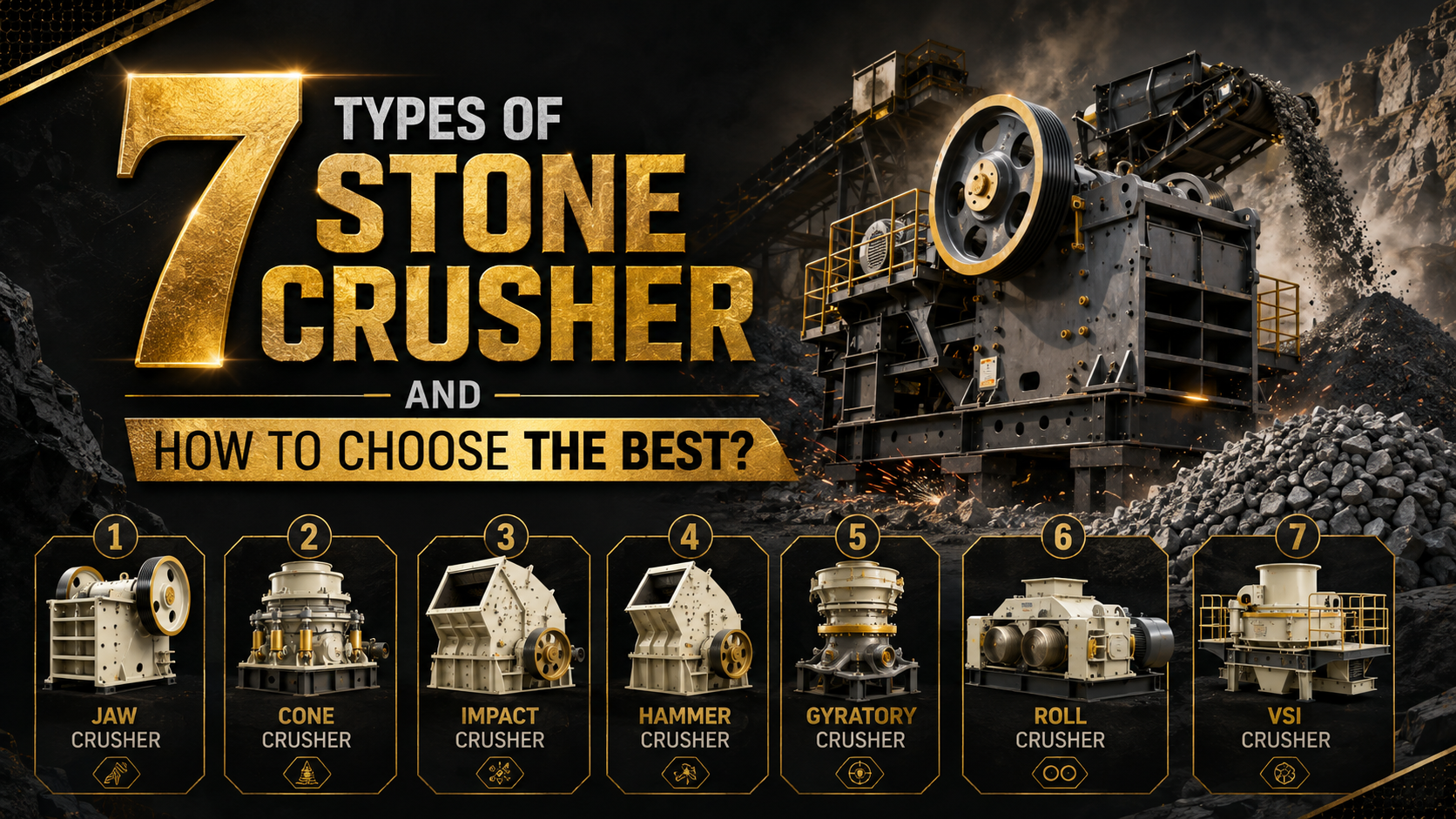
7 Types of Stone Crusher and How to Choose the Best
The best stone crusher depends on feed size, rock hardness, required output size, capacity, particle shape, moisture and operating cost. Jaw and gyratory crushers suit primary crushing, cone and impact crushers suit secondary crushing, while VSI machines are preferred when cubical shape and manufactured sand quality matter most.
7 Types of Stone Crusher
and How to Choose the Best
Jaw, cone, impact, gyratory, hammer, roll or VSI—which crusher is right for your plant? This guide compares how each machine works, what material it handles and where it fits in a crushing line.
One Crusher Cannot Do Every Job Well
Choosing between the different types of stone crusher starts with one question: where will the machine sit in the crushing process? Primary crushers accept large feed from the quarry. Secondary crushers reduce that material further. Tertiary and shaping crushers produce smaller, cleaner and more cubical final products.
A machine that performs well on hard basalt may not be the best choice for soft limestone. A crusher built for high capacity may not produce the particle shape required for premium aggregates or M-Sand. That is why plant design should begin with the rock and product requirement, not with the machine price alone.
Seven Main Types of Stone Crusher
| Crusher Type | Best Stage | Best For |
|---|---|---|
| Jaw crusher | Primary | Large hard-rock feed |
| Gyratory crusher | Primary | Very high-capacity plants |
| Cone crusher | Secondary / tertiary | Hard and abrasive stone |
| Impact crusher | Primary / secondary | Medium-hard stone and better shape |
| Hammer crusher | Primary / secondary | Soft to medium-hard brittle material |
| Roll crusher | Secondary | Controlled reduction with fewer fines |
| VSI crusher | Tertiary / shaping | Cubical aggregate and M-Sand |
Jaw Crusher: The Standard Primary Crusher
A jaw crusher reduces stone by compressing it between a fixed jaw plate and a moving jaw plate. It is one of the most common machines used at the beginning of a stone-crushing line.
Best suited for
Large feed, hard rock, quarry stone, basalt, granite and general primary crushing.
Main advantages
- Simple and proven crushing mechanism
- Accepts comparatively large feed sizes
- Suitable for hard and abrasive stone
- Easy to operate and maintain
- Works well in small, medium and mobile plants
Main limitation
The product is often less cubical than material from an impact or VSI crusher. A secondary crusher is usually required to achieve smaller final sizes.
Gyratory Crusher: Built for High-Capacity Primary Crushing
A gyratory crusher uses a continuously moving crushing head inside a fixed outer shell. Stone is compressed as it travels through the chamber.
Best suited for
Large mines, high-capacity quarry plants and continuous primary crushing where production volume is more important than compact machine size.
Main advantages
- Very high throughput
- Continuous crushing action
- Suitable for hard rock
- Handles large feed with less interruption
Main limitation
Capital cost, civil foundation, machine height and maintenance complexity are higher than for a typical jaw crusher. It is usually unnecessary for a small or medium local aggregate plant.
Cone Crusher: Strong Choice for Hard and Abrasive Stone
A cone crusher compresses material between a moving mantle and a stationary concave. It is widely used after a jaw or gyratory crusher for secondary and tertiary crushing.
Best suited for
Basalt, granite, hard stone and abrasive material where controlled reduction and durable wear performance are important.
Main advantages
- Efficient for hard and abrasive rock
- Good production capacity
- Adjustable output size
- Lower wear cost than impact crushing on very hard stone
- Works well in closed-circuit aggregate plants
Main limitation
A cone crusher generally needs controlled, screened feed. Excessive fines, sticky material or metal contamination can reduce performance. Product shape may still require a VSI stage when premium cubical aggregate is required.
Impact Crusher: Better Shape with High Reduction
An impact crusher breaks stone using high-speed impact from rotating blow bars or hammers. Instead of mainly compressing the rock, it throws the material against impact plates.
Best suited for
Limestone, softer rock, medium-hard material, recycled concrete and applications where a more cubical product is preferred.
Main advantages
- High reduction ratio
- Good particle shape
- Can reduce the number of crushing stages
- Useful for recycling and selected aggregate products
Main limitation
Wear can be high when processing very hard or highly abrasive stone. Blow bars and impact liners may need frequent replacement, which raises operating cost.
Hammer Crusher: Simple Crushing for Brittle Material
A hammer crusher uses rapidly rotating hammers to strike and break material against breaker plates or grates. It can produce a relatively small output in one stage.
Best suited for
Soft to medium-hard, brittle materials such as limestone, coal, gypsum and selected industrial minerals.
Main advantages
- Simple machine layout
- High reduction in one stage
- Can produce smaller output directly
- Lower initial complexity for suitable materials
Main limitation
Hammer wear increases quickly with hard, abrasive rock. Moist or sticky feed can block grates and reduce capacity.
Roll Crusher: Controlled Reduction with Limited Fines
A roll crusher draws material between two rotating rolls and breaks it by compression and, in some designs, shearing. Single-roll, double-roll and toothed-roll versions are available.
Best suited for
Coal, salt, clay, soft stone, friable minerals and applications requiring controlled product size with relatively fewer fines.
Main advantages
- Relatively uniform product size
- Lower generation of fines in suitable applications
- Compact crushing mechanism
- Useful for brittle and low-abrasion material
Main limitation
It is generally not the first choice for large, hard and abrasive quarry stone. Feed size and capacity may be more limited than with jaw, cone or impact crushers.
VSI Crusher: Final Shaping and M-Sand Production
A vertical shaft impact crusher accelerates stone at high speed and breaks it through rock-on-rock or rock-on-anvil impact. It is usually installed at the tertiary or final stage.
Best suited for
Manufactured sand, cubical aggregate, correction of flaky particles and premium final-product shaping.
Main advantages
- Excellent cubical particle shape
- Useful for M-Sand production
- Improves aggregate finish and consistency
- Can reduce flaky and elongated particles
- Works well with screening and air or water classification
Main limitation
A VSI is not normally used as the first machine for large quarry feed. It requires correctly sized input from earlier crushing stages, and wear cost must be evaluated against feed abrasiveness.
Which Stone Crusher Is Best for Each Requirement?
| Requirement | Recommended Crusher | Reason |
|---|---|---|
| Large hard-rock feed | Jaw or gyratory | Strong primary reduction |
| Hard abrasive stone | Cone | Compression crushing and durable wear performance |
| High-capacity primary plant | Gyratory | Continuous high throughput |
| Better cubical aggregate | Impact or VSI | Impact-based shaping |
| M-Sand production | VSI | Controlled shaping and fine production |
| Soft brittle material | Hammer | High one-stage reduction |
| Fewer fines on soft feed | Roll | Controlled compression |
| Mobile quarry setup | Jaw plus cone or impact | Flexible staged crushing |
| Recycled concrete | Impact or jaw | Good reduction and liberation |
How to Choose the Best Stone Crusher
- Identify the feed material, hardness, abrasiveness and moisture level
- Measure the maximum feed size entering the crusher
- Define the required final product sizes and grading
- Set the required tonnes per hour and daily production target
- Decide whether particle shape or only size reduction matters
- Calculate expected wear-part cost for the actual rock type
- Check motor power, fuel use and total energy cost per tonne
- Plan screens, conveyors, recirculation and stockpiles with the crusher
- Confirm access to spare parts and service support
- Allow for maintenance space, foundations and future capacity growth
- Test the feed material or request a process simulation before purchase
- Compare total cost per tonne, not only the machine purchase price
Common Stone Crusher Plant Configurations
For hard basalt or granite
Jaw crusher for primary crushing, cone crusher for secondary reduction, vibrating screens for sizing and VSI for final shaping where premium aggregate or M-Sand is required.
For limestone and medium-hard stone
Jaw crusher followed by an impact crusher can deliver a high reduction ratio and good particle shape. The final selection depends on abrasiveness and wear cost.
For M-Sand production
Primary and secondary crushing prepare the feed, while VSI crushing, screening and classification control shape and fine-particle grading.
For small mobile projects
A mobile jaw crusher followed by a mobile cone or impact crusher offers flexibility when the plant must move between quarry, demolition or road-project locations.
For more detail on final products, read M-Sand vs Stone Dust vs Crusher Dust and 10mm vs 20mm vs 40mm Aggregate.
Stone Crusher Selection Questions
The seven common types are jaw crusher, gyratory crusher, cone crusher, impact crusher, hammer crusher, roll crusher and vertical shaft impact or VSI crusher.
A jaw crusher is commonly used for primary crushing of hard rock, followed by a cone crusher for secondary or tertiary crushing. A VSI may be added when better cubical shape is required.
A VSI crusher is widely used for final shaping and manufactured sand production. It normally receives correctly sized feed from jaw, cone or impact crushing stages.
A jaw crusher usually handles larger feed in the primary stage. A cone crusher receives smaller material and performs secondary or tertiary crushing, especially on hard and abrasive stone.
Neither is always better. Impact crushers often provide higher reduction and better shape on softer or medium-hard feed, while cone crushers are generally more economical on hard and abrasive stone.
VSI and impact crushers are commonly selected when cubical particle shape is a priority. The final result also depends on feed grading, crusher settings, screening and recirculation.
Start with required finished tonnes per hour, expected operating hours, feed gradation, recirculating load, moisture and planned downtime. The machine must be sized for the complete circuit, not only the headline throughput.
The most economical crusher is the one with the lowest total cost per usable tonne for your rock and product. Purchase price, power, wear parts, maintenance, downtime and saleable product quality must all be included.
More Crusher and Aggregate Guides
Choose the Crusher Around the Rock and Final Product
Jaw, gyratory, cone, impact, hammer, roll and VSI crushers each solve a different part of the crushing problem. The right choice depends on feed size, hardness, capacity, desired output, particle shape and total operating cost.
For hard-rock aggregate plants, jaw and cone combinations are common. For softer stone and high reduction, impact crushing may be more suitable. For premium cubical aggregate and M-Sand, VSI shaping is often the final step.
Shriram Group supplies graded crushed-stone products, M-Sand, stone dust, GSB and WMM for construction and infrastructure projects across Yavatmal and surrounding regions.
Need Aggregate from a Reliable Crushing Plant?
Share your required material, aggregate size, quantity, project location and delivery date. Get product guidance and a clear supply quotation.