
Green Building in India 2026 — Which Construction Materials Actually Qualify
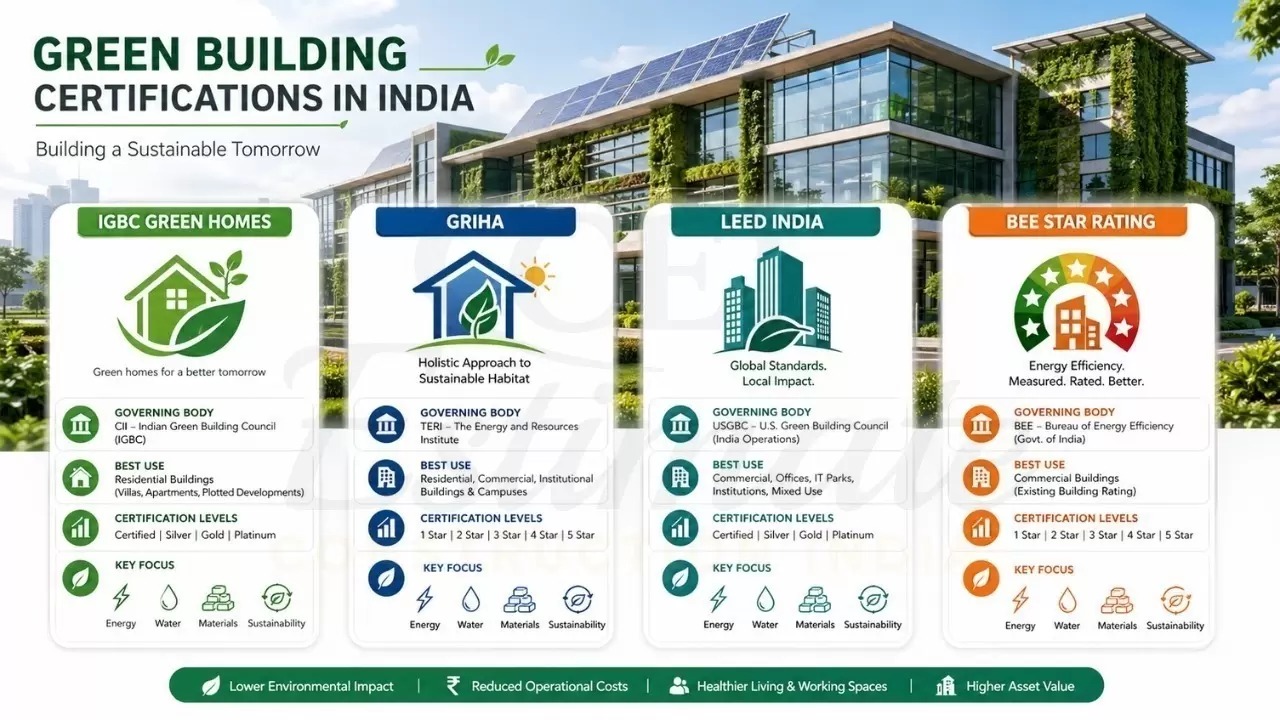
India now has 10,000+ registered green building projects, and IGBC, GRIHA & LEED ratings are becoming mandatory on government and institutional construction. IS 383 certified M-Sand and locally quarried crushed stone contribute 8–13 rating points across five credit categories — regional materials, waste reduction, recycled content, embodied carbon, and certified compliance.
Green Building in India 2026 —
Which Construction Materials Actually Qualify
India now has 10,000+ registered green building projects. IGBC, LEED, and GRIHA ratings are becoming mandatory on government and institutional projects. Builders and developers who don't know which materials count toward certification are leaving points — and project value — on the table.
Green Building Is No Longer Optional
In 2026, green building certification has moved from marketing differentiator to regulatory expectation. The Ministry of Housing and Urban Affairs requires GRIHA ratings on all government buildings above 500 sqm. Smart Cities Mission projects require IGBC or LEED compliance as part of tender eligibility. Several state governments — including Maharashtra — have made green compliance a condition for high-rise approvals in municipal corporations.
For developers and contractors, this creates a practical question: which materials on your standard procurement list actually contribute to a rating — and which don't?
The Three Rating Systems and What They Score
India uses three main green building certification frameworks. Each scores different material categories differently — but all three reward locally sourced, low-embodied-carbon aggregates.
Where Crushed Stone and M-Sand Score Points
Aggregate is the highest-volume material in any construction project. It's also one of the most underused sources of green building credits. Here's where crushed stone and M-Sand contribute directly to rating scores:
| Credit Category | IGBC | GRIHA | LEED v4.1 | How M-Sand / Crushed Stone Qualifies |
|---|---|---|---|---|
| Regional / Local Materials | Up to 4 pts | 3 pts | MRc3 | Quarried within 800 km of project site qualifies. Vidarbha quarries cover all of Maharashtra. |
| Construction Waste Reduction | 2 pts | 4 pts | MRc5 | Consistent IS-graded M-Sand reduces over-ordering and batching waste vs variable river sand. |
| Recycled Content | 2 pts | Partial | MRc4 | C&D waste blended into crushed aggregate contributes to recycled content percentage. |
| Embodied Carbon / Transport | Emerging | 2 pts | MRc1 | Local sourcing cuts transport emissions 50–70% vs distant river sand. Measurable and documentable. |
| Certified / IS-Compliant Materials | 1 pt | 2 pts | Indirect | IS 383 certification is accepted as third-party material verification under both systems. |
The Local Sourcing Advantage — By the Numbers
IGBC and GRIHA both define "regional materials" as those extracted and manufactured within 800 km of the project site. Every Shriram Group plant is within 300 km of the project sites we supply in Maharashtra — well inside the qualifying radius.
Transport Carbon Calculation
A 26-tonne truck travelling 300 km emits approximately 45–55 kg CO?. The same truck travelling 500 km emits 75–90 kg. On a 10,000-tonne aggregate order, the difference is 29–35 tonnes of CO? — a measurable, documentable reduction that feeds directly into the embodied carbon section of a GRIHA submission.
Documentation for Rating Submissions
Green building submissions require material origin documentation. Shriram Group supplies quarry location coordinates, haulage distance calculation, and IS 383 test certificates with every project order — the exact documents a GRIHA or IGBC assessor will ask for.
Materials That Don't Qualify — and Why M-Sand Wins That Comparison
Not all aggregate qualifies for green building credits. Here's what typically gets rejected at assessment stage:
Practical Steps to Maximise Green Credits from Aggregate
- Specify IS 383 Zone II M-Sand from a quarry within 500 km in your material schedule — explicitly name the source quarry
- Request quarry GPS coordinates and distance-to-site calculation from your aggregate supplier at PO stage
- Ask for IS 383 and IS 2386 test certificates dated within 6 months — required for material verification in all three rating systems
- Calculate your aggregate transport emissions using haulage distance × vehicle type — include this in your GRIHA Criterion 8 submission
- If your project uses demolition material, request a C&D waste blended aggregate quote — recycled content percentage boosts MRc4 score
- Document all material challans with quarry origin details — assessors audit spot delivery records, not just purchase orders
- Request a supplier declaration letter confirming extraction site, distance, and IS compliance — one page, saves hours at assessment
What a 4-Star GRIHA Rating Does for a Project
Green ratings translate into measurable financial outcomes, not just plaques on a lobby wall. A 4-star GRIHA rating on a commercial or institutional project in Maharashtra typically delivers:
The Points Are There — You Just Have to Ask for the Right Certificate
Most of the aggregate used on construction projects in Maharashtra already comes from quarries within 800 km. The material is there. The quarry exists. The IS 383 certificate exists. The only thing missing, on most projects, is the documentation request at the time of purchase.
Switching from uncertified river sand to IS 383 certified, locally quarried M-Sand doesn't change your construction method or your structure. It changes your paper trail — and that paper trail is worth 8–13 rating points, a property value premium, and in some cases, tender eligibility itself.
Shriram Group supplies the documentation package your assessor needs with every order. Call us before your next project submission deadline.
Need IS 383 Certified Local Aggregate for Your Green Building Project?
We supply quarry coordinates, distance certificates, IS 383 test reports, and GST invoices — the complete documentation package for IGBC, GRIHA, and LEED submissions. Ready stock within 300 km of Yavatmal.