
How Much Sand & Aggregate Do You Need for House Construction?
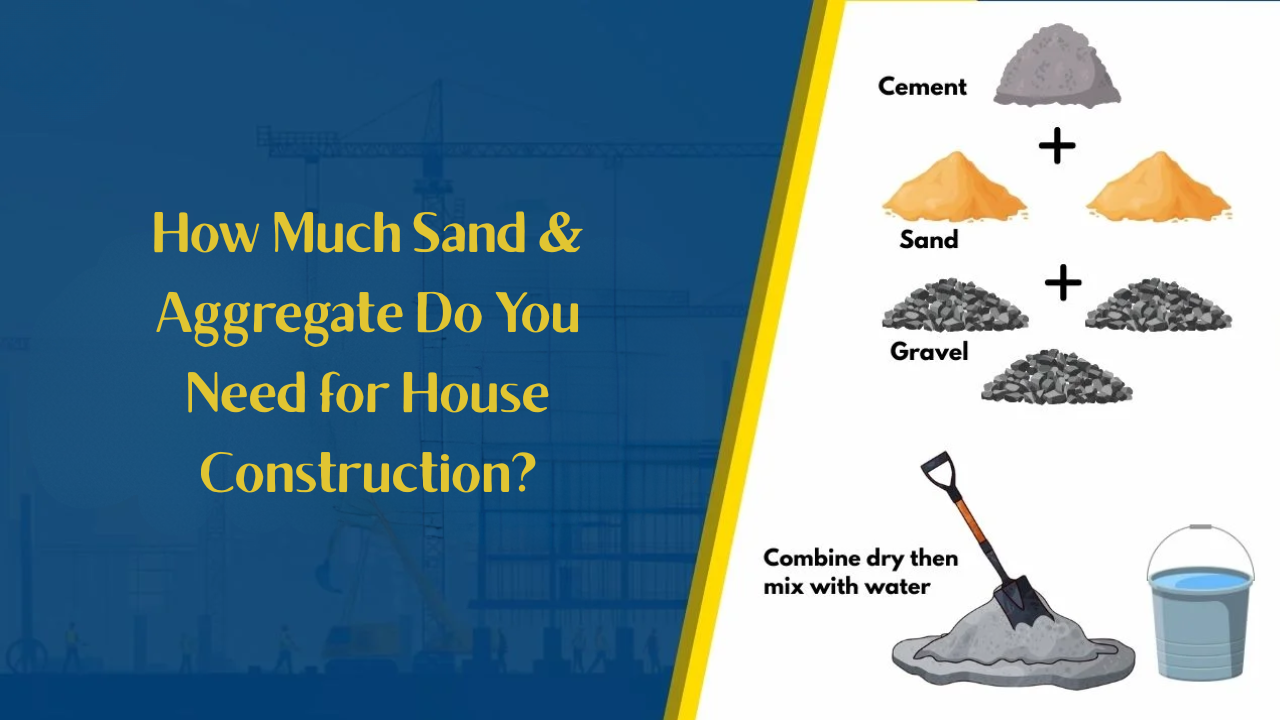
Building a house in Maharashtra and unsure how much sand to order? A standard 1,000 sq ft G+1 house needs roughly 38–45 tonnes of M-Sand for RCC work, 20–26 tonnes of Plaster Sand for wall finishing, and 5–8 tonnes of P-Sand for tile bedding — three different grades that aren't interchangeable. This guide covers quantity estimates for houses from 600 to 1,500 sq ft, the working formula for concrete, plaster, and tile bedding, a full material cost breakdown at June 2026 rates, and five ordering mistakes that cost builders money. Shriram Group supplies all grades IS 383 certified, delivered across Yavatmal, Amravati, Nagpur and surrounding districts.
How Much Sand & Aggregate
Do You Need for House Construction?
The most searched construction question in India — and the one most builders guess wrong. Over-order and you're stuck with leftover stock. Under-order and you're paying urgent delivery rates mid-construction. Here are the actual numbers, room by room and grade by grade, for houses from 600 to 2,000 sq ft.
Why Most Builders Get the Quantity Wrong
There are two common approaches to estimating sand for a house construction project. The first is asking the mason — who typically over-orders because leftover sand is his buffer. The second is asking a dealer — who quotes a round number based on what sells fastest, not what your mix design actually requires.
Neither produces an accurate number. The actual quantity depends on your floor plan area, the number of storeys, slab thickness, wall height, plaster thickness, and the mix ratios your structural engineer specifies. This guide gives you the working formula and standard estimates for the most common house sizes in Maharashtra.
The Three Sand Grades Your House Needs
A standard house construction project needs three different sand grades. They're not interchangeable, and each one goes to a specific part of the structure:
| Grade | Where It Goes | Mix Ratio | % of Total Sand Budget |
|---|---|---|---|
| M-Sand (Zone II) | RCC work — columns, beams, slabs, foundations | 1:1.5:3 or 1:2:4 | ~55–60% |
| Plaster Sand | Internal + external wall plaster, ceiling plaster | 1:4 or 1:6 cement:sand | ~30–35% |
| P-Sand | Tile bedding, paving, driveway base | 1:3 or dry-laid bed | ~8–12% |
Most builders order all their sand as "M-Sand" and use it everywhere. That's the most common source of cracked plaster on newly built houses — M-Sand is too coarse for surface finishing work.
Sand Quantities by House Size — Complete Reference
The estimates below are for a standard G+1 or G+2 residential house in Maharashtra, using M25 concrete for structural work and 12mm internal plaster at 1:4 ratio. Adjust up 15% for G+2 and down 20% for ground floor only.
The Working Formula — Calculate Your Own Quantity
For RCC Structural Concrete
Volume of concrete (m³) × 0.45 = volume of M-Sand needed (m³). At a bulk density of ~1,650 kg/m³ for M-Sand, that's roughly 0.74 tonnes per m³ of concrete. For an M25 mix with 150mm slab thickness: 1 m² slab × 0.15m thickness × 0.45 × 1,650 = ~111 kg of M-Sand per square metre of slab area.
For Wall Plaster
At 12mm plaster thickness with 1:4 cement:sand mortar — each square metre of plastered wall requires approximately 18–22 kg of Plaster Sand. For a 1,000 sq ft house with 3m ceiling height: total wall area ? 280–320 m² (both sides of all walls, less openings) × 20 kg = 5,600–6,400 kg or 5.6–6.4 tonnes per floor.
For Tile Bedding (P-Sand)
At 25mm bedding thickness: 1 m² floor × 0.025m × 1,600 kg/m³ = 40 kg of P-Sand per m². For 1,000 sq ft (93 m²) of tiled floor, that's approximately 3.7 tonnes of P-Sand — before doorstep, bathroom, and outdoor areas.
Always Add 10–12% Buffer
Storage loss, spillage, mixer waste, and batching variation account for 8–12% in a typical residential project. Order the calculated quantity plus 10% minimum. The cost of a small surplus is far less than paying urgent delivery rates to top up a shortfall at the slab-pour stage.
Material Cost Estimate — 1,000 Sq Ft G+1 House
Using current Maharashtra market rates for IS 383 certified M-Sand and Stone Metal, delivered within 150 km of Yavatmal:
Five Ordering Mistakes That Cost Builders Money
Pre-Order Checklist — Before You Call Any Supplier
- Get the structural engineer's BOQ — don't estimate without it for anything above a single room addition
- Identify which sand grades you need — M-Sand, Plaster Sand, P-Sand separately
- Calculate total quantity for each grade including 10–12% wastage buffer
- Decide delivery phasing — foundation pour, slab pour, plaster stage are the three main call-off points
- Ask for IS 383 test certificate and NABL lab details before agreeing price
- Confirm the grade (Zone II for M-Sand, fine grade for Plaster Sand) — not just "M-Sand"
- Get the delivered price to your site — not ex-factory
- Check whether the supplier carries all three grades — ordering from one source simplifies delivery scheduling
Order Right the First Time
A 1,000 sq ft G+1 house in Maharashtra needs roughly 42 tonnes of M-Sand, 23 tonnes of Plaster Sand, 6 tonnes of P-Sand, and 58 tonnes of Stone Metal — around 129 tonnes total delivered. That's not a guess; it's a calculation from standard mix ratios and typical floor plan geometry.
Get the grades right, add the buffer, commit the total quantity for bulk pricing, and order from a supplier who can give you an IS 383 certificate with the first truck. Everything else follows from there.
Shriram Group supplies all three sand grades plus Stone Metal from stock, within 300 km of Yavatmal. Call with your house size and we'll give you a quantity estimate and delivered rate on the same call.
Tell Us Your House Size — We'll Give You the Quantity and Rate
M-Sand, Plaster Sand, P-Sand, and Stone Metal — all grades in stock, IS 383 certified, delivered across Yavatmal, Amravati, Nagpur, Wardha, Nanded and Akola.