
M-Sand vs Stone Dust vs Crusher Dust — What's the Difference?
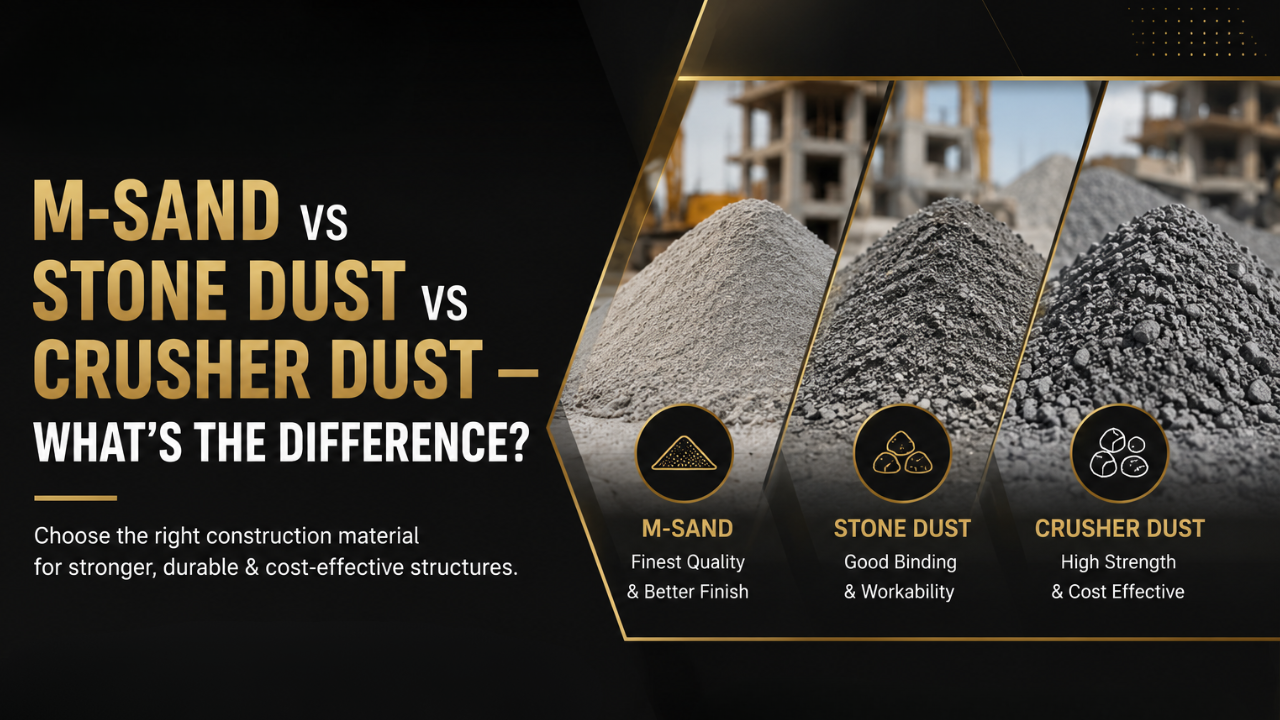
M-Sand vs stone dust vs crusher dust: what's the real difference, how to spot fake M-Sand, and why only one carries an IS 383 certificate.
M-Sand vs Stone Dust vs Crusher Dust -
What's the Difference, and Why It Matters
These three names get used interchangeably across Maharashtra's construction supply market, and that's the problem. They are not the same material, they don't perform the same way in concrete or plaster, and only one of them carries an IS 383 certificate. Here's how to tell them apart before the truck arrives.
Three Names, Three Different Materials
Walk into any building material yard in Maharashtra and ask for "sand," and you might come home with M-Sand, stone dust, or crusher dust, with the dealer often using all three terms for whatever happens to be in the pile that day. That's not a language problem. It's a material identification problem, and it costs people money on every project from a backyard wall to a government tender.
The three terms come from the same source, crushed rock, but represent three different points in the crushing process, with three different quality outcomes. Knowing which is which determines whether your concrete passes a cube test or your plaster cracks within a year.
Material Identification - One Card Each
M-Sand is purpose-made. Granite or basalt is crushed through a VSI (Vertical Shaft Impactor) crusher, then screened and often air-classified or washed to hit a specific particle-size distribution, IS 383 Zone II for structural use. It's engineered to a target, not collected as leftover.
Properly produced M-Sand has angular, cubical particles, controlled fines, and silt content under 1%. It's the only one of the three materials that can carry an IS 383 test certificate from a NABL-accredited lab.
"Stone dust" isn't a defined material, it's a catch-all term used loosely across India for any fine, powdery material from stone processing. In some yards, "stone dust" means properly screened M-Sand. In others, it means raw crusher fines with no classification at all. The term tells you almost nothing about quality.
Because there's no fixed standard behind the name, two suppliers can both sell you "stone dust" and hand over materially different products, one usable, one not. Always ask what's actually inside the bag, not what it's called.
Crusher dust is the fine waste material that falls off the screens during primary and secondary crushing, the leftover fines from jaw and cone crushers making Stone Metal. It's not made on purpose; it's a byproduct that exists whether anyone wants it or not.
Particle shape is flat and irregular rather than cubical, gradation is inconsistent batch to batch, and silt content is unpredictable, often 5-10% or higher. Crusher dust is sometimes sold cheaply as "M-Sand" or "stone dust" to unaware buyers. It fails IS 383 Zone II gradation almost every time it's tested.
Side-by-Side Comparison
| Parameter | M-Sand | Stone Dust | Crusher Dust |
|---|---|---|---|
| How it's made | VSI + classifier, on purpose | Varies, not standardised | Screening byproduct |
| Particle shape | Angular, cubical | Depends on source | Flat, irregular |
| Silt content | Under 1% | Unknown / variable | 5-10%+ |
| Gradation consistency | Controlled, batch to batch | Inconsistent | Highly variable |
| IS 383 test certificate | Standard practice | Rare | Almost never |
| Suitable for RCC concrete | Yes | Verify first | No |
| Suitable for plaster | Yes (fine grade) | Verify first | No |
| Govt. tender acceptance | Accepted with certificate | Rejected without cert | Always rejected |
| Typical price | Rs 1,400-1,800/T | Rs 900-1,400/T | Rs 600-1,000/T |
Where Each Material Actually Belongs
Crusher dust isn't useless, it has legitimate, low-specification uses. The mistake is using it where M-Sand is required, or being sold it as M-Sand without knowing.
How to Tell Them Apart Without a Lab
You won't always have a NABL certificate in hand at the moment of purchase. These field checks help you spot the difference before the truck unloads:
- Rub a handful between your fingers. M-Sand feels gritty and slightly rough; crusher dust feels powdery and clings to skin like flour
- Look at the particle shape with a magnifying glass or phone camera zoom. M-Sand particles are roughly cubical; crusher dust is flat and splintery
- Do the bottle settling test. Fill a clear bottle one-third with sand, add water, shake, let it settle for an hour. M-Sand shows a thin silt layer under 4mm; crusher dust shows a thick cloudy layer of 10mm or more
- Check the colour consistency. M-Sand from a single quarry batch is uniform in colour; mixed crusher dust and stone dust often shows colour variation from blended sources
- Ask the supplier directly which crusher produced it. If there's no VSI in their plant, what you're buying isn't engineered M-Sand
- Request the IS 383 certificate before agreeing on price. This is the only conclusive test; everything else is a useful first filter
Why the Confusion Exists in the First Place
Regional Language Differences
In parts of Maharashtra, "stone dust" is used to describe what is actually properly screened M-Sand from a reputable plant. In other regions, the same term describes raw crusher fines. There's no enforced national terminology, the words shift meaning by district and by dealer.
Relabelling at the Yard
Some stockyards buy crusher dust cheaply from quarries as a byproduct and resell it labelled simply as "sand" or "M-Sand" without disclosure. The buyer has no way to know unless they ask for testing documentation.
Visual Similarity
To an untrained eye, a pile of M-Sand and a pile of crusher dust look almost identical, both grey, both granular. The difference shows up in particle shape, silt content, and gradation, none of which are visible from a few metres away.
What Shriram Group Actually Supplies
We don't sell crusher dust as M-Sand, and we don't use "stone dust" as a vague catch-all term on our invoices. Every product leaving our 6 plants is named for what it is, with the documentation to prove it.
Our M-Sand is produced through the full VSI sand-making circuit with air classification, tested for IS 383 Zone II compliance, and certified by a NABL-accredited lab on every batch. If you ask what crusher made it, the answer is on record. If you ask for the silt content, it's on the certificate that comes with the delivery, not something you have to chase down afterward.
Same Rock, Three Different Products
M-Sand, stone dust, and crusher dust all start as the same granite or basalt. What separates them is the process, engineered VSI production versus generic regional naming versus unprocessed byproduct. Only one of the three is built to a standard, and only one of the three can carry the certificate that protects your structure and your project.
The fix isn't memorising which term means what in your district. It's asking for the IS 383 certificate every time, regardless of what the material is called on the invoice.
Shriram Group sells M-Sand because it's M-Sand, certified, tested, and named correctly on every delivery.
Get IS 383 Certified M-Sand, Not Crusher Dust in Disguise
Every batch tested, every certificate provided, every delivery documented. M-Sand, Plaster Sand, P-Sand and Stone Metal in stock, delivered across Yavatmal, Amravati, Nagpur, Wardha, Nanded and Akola.