
River Sand and Pit Sand - Why Their Best Days Are Behind Them
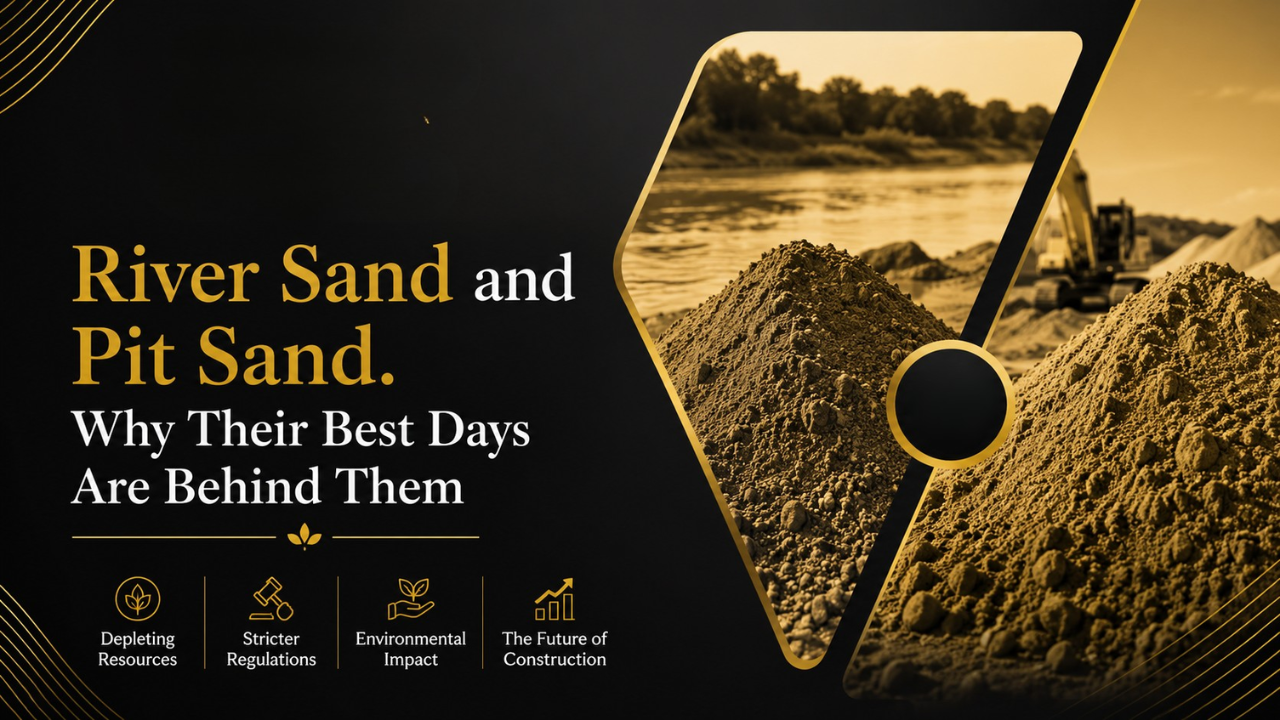
River sand and pit sand built most of India's older housing stock, but neither was ever made to a standard, and both are now running into legal and quality trouble. Silt content in river sand typically runs 3 to 8 percent, pit sand often worse, and prices have climbed 60 to 120 percent since 2018 as extraction bans tightened across the country. This guide explains what separates the two materials, why river sand mining keeps getting restricted.
River Sand and Pit Sand -
Why Their Best Days Are Behind Them
River sand and pit sand built half of India before anyone asked where they came from. Now the rivers are running thin, the pits are getting harder to dig legally, and the material itself was never as consistent as people assumed. Here's what these two actually are, why they're disappearing from job sites, and what's replaced them.
What River Sand and Pit Sand Actually Are
River sand is exactly what it sounds like. It's dredged from riverbeds, where centuries of water flow have rounded and sorted the grains. Pit sand comes from inland pits and quarries, usually a few feet underground, where ancient river systems or weathering left deposits of sand mixed with clay, silt, and organic matter.
Both were the default building material in India for generations, mostly because they were cheap, local, and nobody was checking the silt content. River sand has smooth, rounded particles from water erosion. Pit sand is angular but often comes loaded with clay and impurities that have to be washed out before it's usable.
Neither one was ever made to spec. Someone just dug it up and somebody else bought it.
The Two Materials, Side by Side
Rounded, smooth particles from years of water erosion. Good natural workability in concrete and mortar, which is why masons have always liked it. The problem is everything else: silt content runs 3 to 8 percent depending on the source, gradation varies by season and by which stretch of river it came from, and extraction is now restricted or banned outright across most of India.
Angular grains, which in theory should bond better in concrete than river sand's smooth ones. In practice, pit sand usually carries a heavier clay and silt load than river sand, sometimes 8 percent or more, and it needs washing before anyone should use it structurally. Most pit sand sold in India never gets that wash. It goes straight from the ground to the truck to your site.
Why River Sand Mining Is Disappearing
This part isn't really in dispute anymore. Riverbeds that get dredged year after year start collapsing at the banks. Groundwater tables drop because the riverbed no longer holds water the way it used to. Fish breeding grounds get wiped out. Bridges built on the assumption of a stable riverbed start showing stress.
The Supreme Court and the National Green Tribunal have been tightening river sand rules since 2012, and the pace has picked up since 2018. Mining without an Environmental Clearance is now a criminal offence under the Environment Protection Act, with penalties that include jail time. Most states ban extraction outright during the monsoon and during fish-spawning months, which knocks out four to six months of supply every single year.
None of this stopped demand. It just pushed a chunk of the trade underground, which is its own problem if you're the one buying the sand.
The Quality Problem Nobody Talks About
Even setting the legal mess aside, river sand and pit sand were never great materials by any consistent measure. They were just familiar.
Silt content is the big one. Past 3 percent, it starts pulling water out of your cement paste, and you end up either thinning the mix or throwing more cement at the problem. River sand routinely sits above that line. Pit sand tends to be even dirtier, because clay clings to grains underground in a way flowing water just rinses away.
Gradation is the other problem, and it's a strange one once you notice it. A load from upstream looks nothing like a load taken five kilometres down the same river. Every delivery is a small gamble until somebody actually tests it. Pit sand isn't any better; the variation can shift from one side of the pit to the other.
| Issue | River Sand | Pit Sand |
|---|---|---|
| Silt content | 3-8%, variable by source | 8%+, often unwashed |
| Gradation consistency | Changes by stretch of river | Changes within the same pit |
| Organic content | Shells, plant matter | Clay, soil, occasional roots |
| IS 383 certificate | Almost never provided | Almost never provided |
None of this means river sand or pit sand is unusable in every situation. It means you can't trust a load without testing it, and most sites never test it.
What Happened to the Price
River sand has gone up 60 to 120 percent in major Indian markets since 2018. Some of that is genuine scarcity. Some of it is the black market premium that comes with buying a restricted material from a supplier who isn't exactly advertising where it came from.
Pit sand has followed a similar curve in regions where local pits have been depleted or shut down for permit violations. There's a strange irony here: the material that used to be the cheap option is now, in a lot of markets, more expensive than the engineered alternative that replaced it.
What's Replaced Them
Manufactured sand, M-Sand, is what most of the construction industry has shifted to. It's crushed granite or basalt run through a VSI crusher, screened to a controlled gradation, and tested to IS 383 before it leaves the plant. Silt content stays under 1 percent because the production process controls it directly, instead of hoping a river happened to wash it clean.
It's not a perfect like-for-like swap. River sand has a workability that takes some admixture tuning to replicate in M-Sand. That's a solved problem by now, though, and most contractors who've made the switch once don't spend much time looking back. Consistent gradation and no silt surprises tend to settle the argument fast.
Twelve or more Indian states now mandate M-Sand for government construction. That's not a marketing claim. It's policy, and it exists because river sand and pit sand stopped being a sustainable way to build things.
If You're Still Using River Sand or Pit Sand
Some applications still see river sand or pit sand in use, mostly small private jobs where nobody's checking. If that's your situation, a few things are worth doing before the load gets mixed into anything structural:
- Ask for documentation on where it was sourced and whether the supplier has a valid permit for this season
- Run the bottle test yourself before you trust a load. Sand a third of the way up a clear bottle, top with water, shake, and wait an hour. Anything past a 4mm silt layer on top means trouble
- Never use it on a government project or anything requiring RERA compliance. It will not pass inspection
- Factor in the extra cement you'll likely need to compensate for higher silt. It changes the real cost comparison against M-Sand
- If buying during monsoon season, ask directly how the supplier is legally sourcing material when extraction bans are typically in force
River Sand and Pit Sand: Common Questions
Not nationally, but most states restrict or seasonally ban it. Mining river sand without a valid Environmental Clearance is a criminal offence under the Environment Protection Act, 1986. Several states, including Maharashtra, Karnataka, Kerala, and Tamil Nadu, have additional state-level restrictions on top of that, and extraction is typically banned outright during monsoon months.
River sand is dredged from riverbeds and has smooth, rounded particles from water erosion. Pit sand is dug from inland pits and quarries and has angular particles, but it usually carries more clay and silt because there's no flowing water to wash it clean. Both lack the consistent gradation and certification you get with manufactured sand.
Only if it's washed and tested first. Raw, unwashed pit sand carries too much clay and silt for structural concrete or plaster. If a supplier can't show you a silt content test, treat it the same way you'd treat untested river sand: useful for low-spec fill work, risky for anything load-bearing.
Prices have risen 60 to 120 percent in major Indian markets since 2018. Tighter extraction rules cut legal supply, monsoon bans remove four to six months of mining every year, and a chunk of remaining supply now carries a black-market premium. The material that used to be the cheap option is, in many regions, now pricier than IS 383 certified M-Sand.
Run the bottle test before you trust a load. Fill a clear bottle a third full with sand, top it with water, shake, and let it settle for an hour. A silt layer thicker than 4mm on top is a warning sign. It's not a lab test, but it catches the worst material before it goes into your mix.
In practice, no. PWD, PMGSY, and NHAI projects require IS 383 certified material with valid test documentation, which untested river sand or pit sand almost never has. RERA-registered developers face the same problem: using uncertified material is grounds for buyer complaints and compliance penalties.
For structural concrete and plaster, yes, and in most independent testing it outperforms river sand on compressive strength because of better gradation control and lower silt content. The one adjustment is workability, since M-Sand's angular particles behave a bit differently than rounded river sand grains. A small amount of admixture tuning closes that gap.
An Honest Goodbye
River sand and pit sand aren't villains. They built most of the country's older housing stock, and for a long time there wasn't a serious alternative. But the rivers can't keep up with current demand, the pits are running into the same permit and quality problems, and the material itself was never as reliable as everyone assumed.
M-Sand exists because someone looked at all of this and built a process that solves it directly: controlled silt, controlled gradation, a certificate you can actually check. It just means somebody finally started measuring the thing the industry had been guessing at for decades.
Shriram Group has been making that switch easier in Maharashtra since 1988, supplying IS 383 certified M-Sand to anyone who'd rather know what's in their concrete than hope for the best.
Get IS 383 Certified M-Sand Instead
Tested, documented, and in stock. M-Sand, Plaster Sand, P-Sand and Stone Metal delivered across Yavatmal, Amravati, Nagpur, Wardha, Nanded and Akola.