
Types of Stone Crusher. Which One Does What and When to Use It
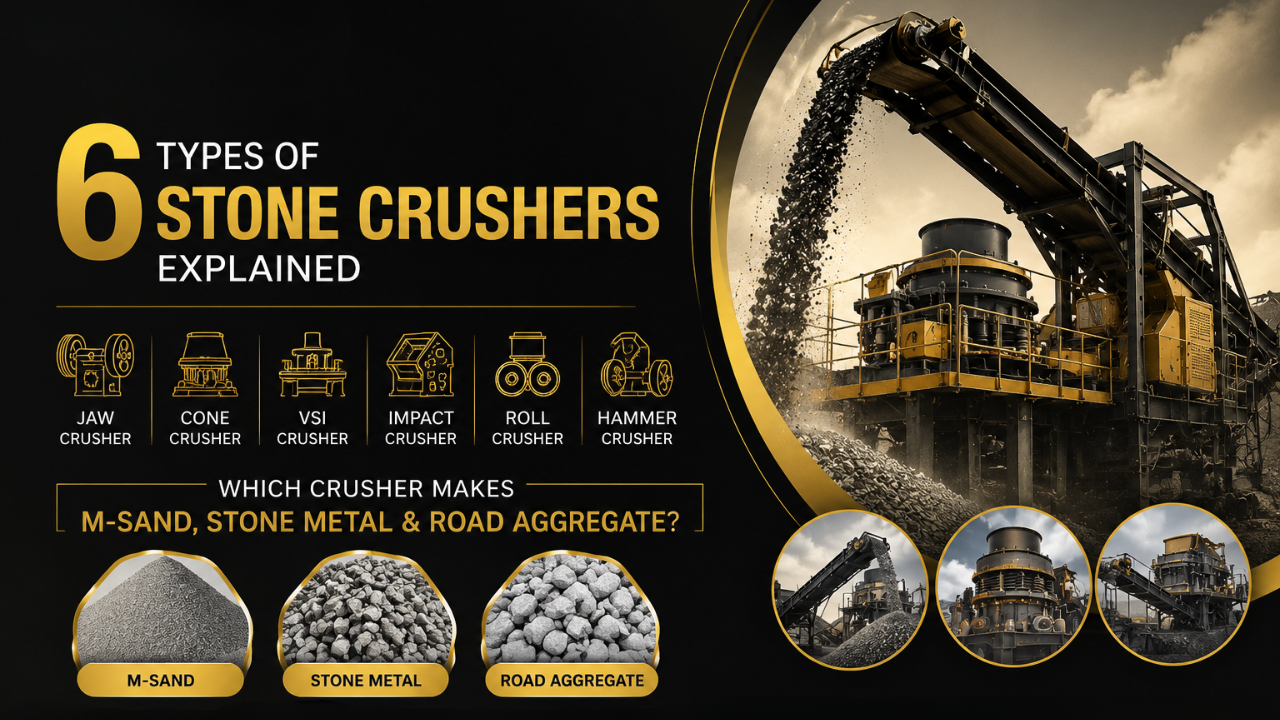
6 types of stone crushers explained jaw, cone, VSI, impact & more. Which crusher makes M-Sand, Stone Metal & road aggregate. Shriram Group, Maharashtra.
Types of Stone Crusher —
Which One Does What and When to Use It
Jaw crusher, cone crusher, impact crusher, VSI, roll crusher — each one breaks rock differently and produces a different output. Pick the wrong type for your material or application and you get the wrong gradation, excess wear, or unnecessary cost. Here's how each type works, what it's used for, and which one produces the M-Sand and aggregate you actually need.
What a Stone Crusher Actually Does
A stone crusher breaks large rocks — granite, basalt, limestone, quartzite — into smaller, usable sizes. The output is aggregate: the crushed stone and manufactured sand that goes into roads, buildings, bridges, and concrete. Without crushers, there's no construction material.
The confusion starts because "stone crusher" covers six fundamentally different machines, each using a different method to break rock — compression, impact, shear, or attrition. The method determines the particle shape, size distribution, and which applications the output is suitable for.
In India, the stone crushing industry is growing at 7.8% CAGR through 2032, driven by Bharatmala, PMGSY, Smart Cities, and a massive residential construction boom. Understanding which crusher produces which material is the difference between supplying a government road project and being rejected at the quality checkpoint.
The 6 Main Types of Stone Crusher — Explained
The jaw crusher is the most widely used primary crusher in India. It works by compression — a fixed jaw and a moving jaw create a V-shaped chamber that squeezes rock until it breaks. Large rocks up to 1,500mm are fed from the top and exit as smaller pieces from the bottom.
It's the first machine in most crushing plants, taking run-of-mine rock and reducing it to 150–300mm for secondary processing. Simple design, low maintenance, and the ability to handle hard abrasive rock (granite, basalt) make it the default first-stage choice.
The cone crusher works by compression between a rotating cone (mantle) and a fixed bowl liner. As rock enters the top, it's squeezed between the two surfaces and breaks along natural fracture lines. The output is more cubical than jaw crusher product — important for high-quality aggregate.
Cone crushers produce the 20mm and 10mm Stone Metal grades used in DBM road layers and structural concrete. They also handle the intermediate crushing stage between jaw output and VSI/impact crushing. In Shriram Group's plants, cone crushers are the backbone of the 20mm and 40mm Stone Metal production.
The impact crusher breaks rock using high-speed impact rather than compression. A rotor with fixed hammers spins at high speed — rock fed into the chamber is struck by the hammers and thrown against impact plates, breaking along cleavage planes. The result is a more cubical product with a higher fines content than cone output.
Impact crushers work best on softer to medium-hard rock (limestone, dolomite) and are less suited to hard abrasive granite — the wear on hammers and liners increases significantly with rock hardness. For sand and gravel processing and limestone quarrying, they're a cost-effective secondary stage machine.
The VSI is the machine that makes M-Sand. Rock is fed into a high-speed rotor and thrown outward by centrifugal force, striking a rock-lined chamber at 65–70 m/s. Rock breaks against rock (autogenous crushing) — producing angular, cubical particles that closely mimic natural sand particle shape.
This is the critical difference between VSI-produced M-Sand and the output of any other crusher type. The rock-on-rock impact creates the surface texture and angularity that gives M-Sand its superior concrete bond strength. Without a VSI stage, you can't produce IS 383 Zone II M-Sand from granite. All six Shriram Group plants use VSI technology for M-Sand production.
Two parallel cylinders rotating in opposite directions pull rock between them and crush it by compression and shear. Roll crushers produce a more controlled, uniform output size than jaw or impact crushers — the gap between the rolls directly determines maximum product size.
Common in coal crushing, soft mineral processing, and fertiliser applications. Less common in granite quarrying because the rolls wear quickly with hard, abrasive rock. In construction aggregate production, roll crushers are occasionally used as a tertiary stage for close-size control on specific product grades.
The gyratory crusher works similarly to a cone crusher but on a much larger scale — designed for very high-tonnage primary crushing in large mining operations. A conical head gyrates inside a concave bowl, crushing rock by compression continuously around the full circumference.
Gyratories handle feed sizes up to 2,000mm and output capacities exceeding 5,000 TPH. They're used in large iron ore, copper, and gold mines — not in the typical construction aggregate quarry in Maharashtra. For construction purposes, the jaw crusher handles the same primary crushing role at a fraction of the capital cost.
All 6 Types at a Glance
Side by side, the differences become clear — especially for anyone trying to match a crusher type to a specific output requirement:
| Crusher Type | Crushing Method | Output Size | Best Rock | Stage | M-Sand? |
|---|---|---|---|---|---|
| Jaw Crusher | Compression | 150–300mm | All hardness | Primary | No |
| Cone Crusher | Compression | 10–50mm | Medium–Hard | Secondary | No |
| Impact Crusher | Impact | 0–40mm | Soft–Medium | Secondary | Limited |
| VSI Crusher | Rock-on-rock | 0–6mm | All hardness | Tertiary | Yes — IS 383 |
| Roll Crusher | Compression + shear | 2–50mm | Soft minerals | Tertiary | No |
| Gyratory | Compression | 150–300mm | All hardness | Primary | No |
How a Complete Crushing Plant Works — Stage by Stage
No quarry uses a single crusher. Production runs in stages — each stage reducing the rock further and producing a specific size range. Here's how a typical granite quarrying plant like Shriram Group's operates:
Which Crusher Produces Which Construction Material
If you're a contractor or buyer asking "which crusher makes the material I need", the table below gives you the direct answer:
| Material You Need | Crusher Type That Makes It | IS Standard | Application |
|---|---|---|---|
| GSB Aggregate 40mm | Jaw + Cone (Stage 1+2) | IS 2386, MoRTH 400-1 | Road sub-base |
| WBM Stone 90–40mm | Jaw (Stage 1 output) | IS 2386 | Road base course |
| Stone Metal 20mm | Cone Crusher (Stage 2–3) | IS 2386 Part III | Concrete & DBM |
| Stone Metal 10–12mm | Cone Crusher (Stage 3) | IS 2386 | Fine concrete, drainage |
| Stone Metal 6mm | Cone / Impact (Stage 3) | IS 2386 | Filter & drainage layers |
| M-Sand (IS 383 Zone II) | VSI Crusher (Stage 4) | IS 383:2016 | Structural concrete |
| Plaster Sand (fine) | VSI + Air Classifier | IS 383 (fine zone) | Wall plaster & finishing |
| P-Sand | VSI + Wet Wash | IS 383 | Paving & tile bedding |
How to Tell if M-Sand Was Made by a VSI — or Wasn't
Substandard M-Sand made from jaw crusher or cone crusher fines without a VSI stage is sold in Maharashtra at lower prices. It looks similar but fails IS 383 tests. Here's how to tell the difference before you order:
- Ask for the IS 383 test certificate — silt content should be under 1%, FM between 2.6–3.2, specific gravity 2.55–2.70
- Check the gradation curve on the certificate — Zone II should show a smooth S-curve, not a steep step at one sieve size
- Ask whether the plant has a VSI — if the answer is "what's a VSI?" or a hesitation, the M-Sand was made from crusher fines, not a sand-making machine
- Look at the particle shape — VSI M-Sand is visibly cubical and angular under close inspection; crusher dust is flat, flaky, and irregular
- Do a field silt test — fill a bottle ? with sand, fill with water, shake and let settle. The silt layer on top should be under 4mm. Crusher dust often shows 10–15mm
- Ask for the NABL lab name on the certificate — any legitimate IS 383 test is done by an accredited lab with a registration number
Shriram Group's Crushing Setup — 6 Plants, Full Circuit
Since 1988, Shriram Group has operated granite quarrying and crushing plants in the Yavatmal region of Maharashtra. All 6 plants run the complete 4-stage crushing circuit — primary jaw, secondary cone, tertiary cone, and VSI sand-making — with air classification for IS 383 M-Sand production.
What This Means for Buyers
Every grade we produce comes from the right machine for that grade. The 20mm and 40mm Stone Metal comes from cone crushers running the correct closed-side settings. The IS 383 M-Sand comes from VSI crushers with air classification controlling the fines. Plaster Sand goes through an additional wet-washing stage. Each product has its own tested gradation — nothing is blended or relabelled.
Combined Output
1,150 TPH across 6 plants means we carry ready stock in all grades year-round. Government projects get priority scheduling for large orders with phased delivery. Residential and commercial buyers get same-day dispatch on standard grades within 300 km of Yavatmal.
The Crusher Type Tells You What's in the Bag
Jaw crusher makes primary reduction. Cone crusher makes Stone Metal. VSI makes M-Sand. Impact crusher handles softer rock and recycling applications. The type of crusher isn't a technical detail — it's the explanation for why two bags of "M-Sand" can perform completely differently in the same concrete mix.
When you buy from a plant that runs the full circuit — jaw, cone, VSI, classifier — you get the product that was designed for your application. When you buy crusher dust relabelled as M-Sand, you find out at the cube test.
Shriram Group runs the full circuit at 1,150 TPH. The VSI produces the IS 383. The certificate proves it.
M-Sand, Stone Metal & Plaster Sand — All Grades in Stock
Full 4-stage crushing circuit. IS 383 and IS 2386 certified. GST invoiced. Delivered across Yavatmal, Amravati, Nagpur, Wardha, Nanded & Akola within 300 km.