
Why Has River Sand Become So Expensive?
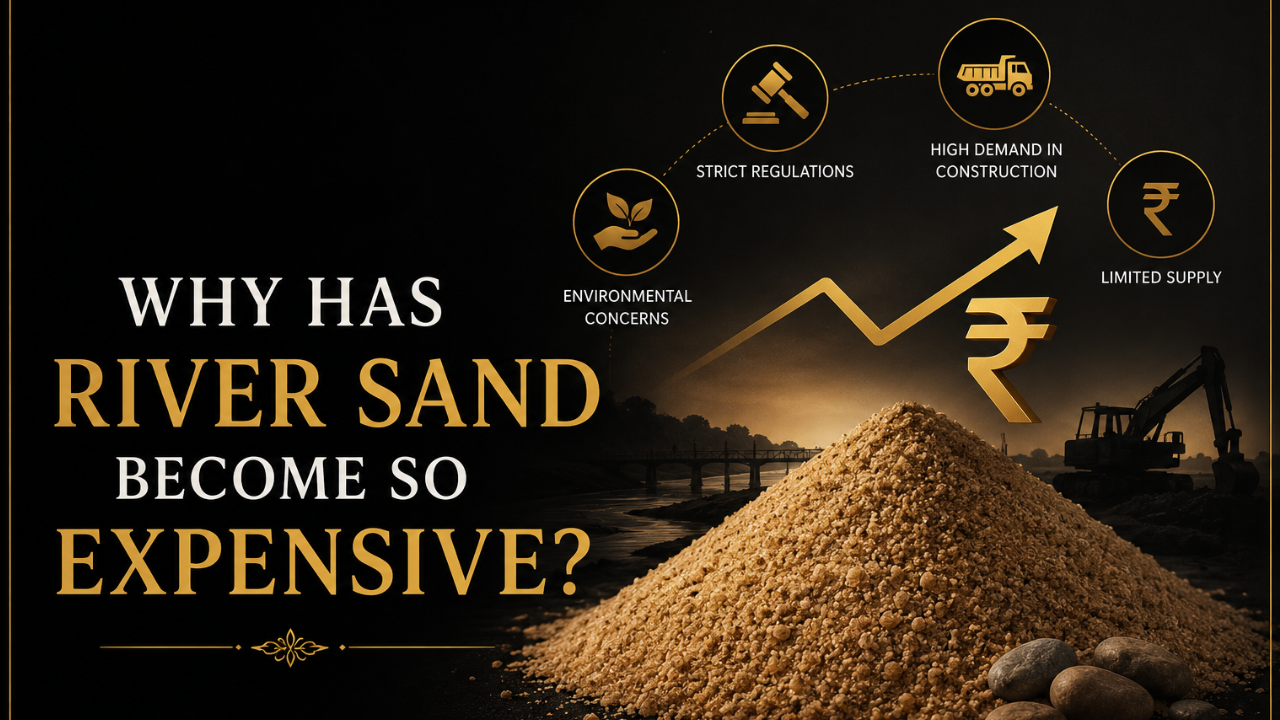
River sand now costs 40 to 50 percent more than M-Sand per tonne, and the gap keeps widening rather than closing. Legal mining supply has dropped roughly 40 percent in five years due to stricter environmental enforcement, monsoon bans cut supply for three to four months annually, and transport now accounts for 20 to 35 percent of the final price as approved extraction sites shrink.
Why Has River Sand
Become So Expensive?
Ten years ago river sand was the cheap, obvious choice. Now it's often the priciest sand on the rate card, sometimes by a wide margin. Here's what actually happened, with the numbers behind it.
The Short Version
River sand got expensive for two reasons that compound each other. There's a lot less of it available legally, and what's left has to travel further to reach you. Monsoon bans, royalty charges, black market premiums, all of it traces back to one of those two facts.
The change happened faster than most people expected. A material that used to be the default cheap option in any Indian construction budget is now, in a lot of regions, the most expensive sand you can buy, costing 40 to 50 percent more than manufactured sand for what used to be a basic commodity.
What's Actually Driving the Price Up
Five things stack on top of each other to produce the rates you're seeing today.
The Numbers, Side by Side
Current 2026 rates make the gap concrete instead of abstract:
| Material | Price Per CFT | Price Per Tonne | Trend |
|---|---|---|---|
| River sand | Rs 45-110 | Rs 2,200-3,500 | Rising |
| M-Sand | Rs 32-70 | Rs 800-1,800 | Stable |
| Robosand (premium M-Sand) | Rs 35-65 | Rs 900-1,900 | Stable |
Rates vary by state and by how far you are from a quarry or riverbed, but the direction is the same everywhere. Industry market analysis points to the same root cause behind the spread: tighter mining regulation pushing buyers toward manufactured alternatives, not because M-Sand suddenly got cheaper, but because river sand kept getting more expensive while M-Sand held steady.
Why This Isn't a Temporary Spike
It's tempting to treat this as a cycle that'll correct itself once supply catches up. It probably won't, and the reason is structural rather than seasonal. Riverbeds don't replenish sand at anywhere near the rate it's extracted. A quarry can run for decades because the rock is just sitting there. A riverbed that's been over-mined takes geological time to recover, which in practical terms means it doesn't.
Government policy has settled in the same direction. The updated National Sustainable Sand Mining Guidelines made stricter mining permissions and quarterly inspections the norm, not the exception, and there's no political signal anywhere suggesting that loosens up. If anything, the rules tend to get tighter every few years, not looser.
What This Means If You're Budgeting a Project Right Now
A few practical adjustments follow directly from all of this:
- Price river sand and M-Sand separately in your budget instead of assuming one number for "sand," since the gap between them is now wide enough to matter
- If your project timeline overlaps monsoon season, lock in pricing before the rainy months start, since rates typically climb 15 to 25 percent once mining bans take effect
- Check the distance from your site to the nearest legal source before assuming a quoted price is representative, since transport alone can shift the final number by a third
- For structural concrete, compare river sand and M-Sand on total project cost, not just sand price, since M-Sand's lower silt content often reduces cement usage too
- If you're still using river sand for plastering by preference, budget for it as a premium finish material rather than a default choice
Common Questions About River Sand Pricing
River sand now costs roughly 40 to 50 percent more than M-Sand per tonne, and prices climb a further 15 to 25 percent during monsoon months when mining is restricted. Legal supply has dropped about 40 percent over the past five years, which is the main driver behind the long-term price trend.
Unlikely in the near term. The price increase is driven by mining restrictions and depleted riverbeds, not a temporary supply hiccup. Regulation has consistently tightened rather than loosened, and riverbeds don't replenish at anywhere near the rate they're mined.
Riverbed mining becomes physically impossible once water levels rise, and most states formally ban extraction during these months anyway. Supply drops sharply for three to four months every year, and prices rise 15 to 25 percent to match.
Genuinely cheaper, by 25 to 35 percent on average, and that gap has widened rather than narrowed as river sand supply has tightened. M-Sand also tends to need less cement to achieve the same strength because of lower silt content, which lowers total project cost beyond just the sand price.
Transportation now accounts for 20 to 35 percent of the final price, and that share grows quickly for any project located more than 100 km from a legal extraction site. As approved mining locations shrink, average haul distances increase, and freight cost rises with it.
Where to Go Next
The Math Has Quietly Flipped
River sand used to be the budget option by default. It isn't anymore, and the gap has been widening for years, not closing. Less legal supply. Longer hauls. A monsoon shutdown every single year. A black market that charges more, not less, for the risk involved.
Shriram Group supplies IS 383 certified M-Sand at stable, predictable pricing, without the monsoon spikes or supply gaps that come with river sand.
Get IS 383 Certified M-Sand at Predictable Rates
No black market premium, no seasonal shutdown. M-Sand, Plaster Sand, P-Sand and Stone Metal in stock, delivered across Yavatmal, Amravati, Nagpur, Wardha, Nanded and Akola.